Basics
An independent test found 2.4x fewer quality issues with Emporia's respondents compared to other high quality providers.

Written by:
Ashley Lapin
September 15, 2026
5 min read

GroupSolver ran a brand positioning study for a payroll and HR platform, sourced respondents from three providers and assessed the quality of each. Emporia had the lowest rate of quality terminations. Provider A had 2.4 times more quality terminations than Emporia and Provider B had 1.7 times more quality terminations.
Key findings
- GroupSolver fielded a brand positioning study for a payroll and HR platform with small business decision makers and CPA and accounting advisors.
- The study sourced respondents from three separate providers.
- GroupSolver applied its own fraud detection to every respondent, using randomized in-survey quality questions, device fingerprinting and a behavioral AI model tracking roughly thirty variables.
- When compared to two other sample providers, both of which promote their high quality respondents, Emporia has 2.4 times fewer quality terminates than Provider A and 1.7 times fewer than Provider B.
- The survey, the screener, the detection method and the field window were identical for all three providers. The only variable that changed was the source of the respondents.
How the study was designed.
GroupSolver, an AI-powered market research and survey platform that turns open-ended qualitative feedback into structured, quantitative data, ran a brand positioning study on behalf of a payroll and HR platform that serves small businesses. The objective was to identify the strongest positioning message and to select AI language that the target audience found credible, clear and differentiated from competing claims.
The study was conducted with two audiences. The first was CPA and accounting advisors (n=113). These respondents advise small business clients on payroll and HR matters, and they influence which solutions reach a shortlist. The second audience was small business decision makers (n=336). These respondents are directly involved in HR, payroll or finance decisions at their companies.
Emporia and two other sample providers (represented here as Provider A and Provider B) supplied respondents for that survey.
How GroupSolver assessed respondent quality.
GroupSolver ran a wide range of quality control measures on its own platform, using the same four layers on every respondent.
Randomized in-survey quality control questions
Randomized quality control questions are checks placed inside a survey to confirm a respondent is reading and answering honestly. Common examples include an instruction to select a specific answer, a question with a known correct answer or two questions that should produce consistent responses. The survey pulls each check at random from a larger bank, so different respondents see different questions. This is what makes the checks hard to beat. When a survey uses the same check every time, frequent respondents can memorize it and pass it without paying attention. Pulling from a bank means nobody knows which check is coming.
Device fingerprinting
Device fingerprinting identifies the specific computer or phone a respondent is using. It collects technical details the device shares automatically, including browser version, screen size, operating system, time zone and installed fonts. Combined, those details form a signature that is close to unique. Researchers use it to catch one person entering the same survey many times under different identities, which is one of the most common forms of survey fraud. It also flags devices using a VPN or an emulator to appear as though they are somewhere they are not.
AI-powered behavioral analysis
Behavioral analysis looks at how someone takes a survey, separate from the answers they give. It tracks signals like how fast a respondent moves through questions, how the mouse moves, whether text was pasted in from somewhere else, whether the same grid row is selected every time and whether the person switched to another browser tab mid-survey. Real respondents produce messy, varied patterns. Fraudulent respondents and bots produce patterns that repeat. Reviewing those signals across many respondents makes it possible to identify and remove bad data that looks perfectly reasonable on the surface.
Delayed termination
GroupSolver does not terminate a suspected respondent immediately. A flagged respondent is allowed to finish the survey, which lets the platform learn from the complete behavioral pattern and prevents that respondent from identifying which question caught them. Platforms that terminate on the spot teach fraudulent respondents exactly where the detection sits, which makes the next attempt harder to catch.
What the results showed
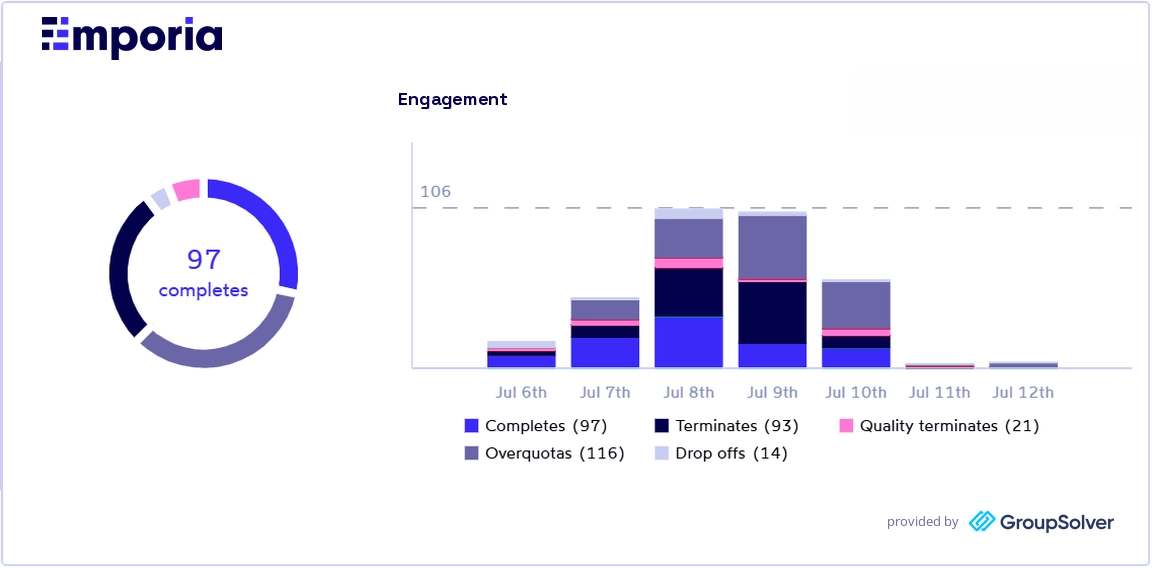
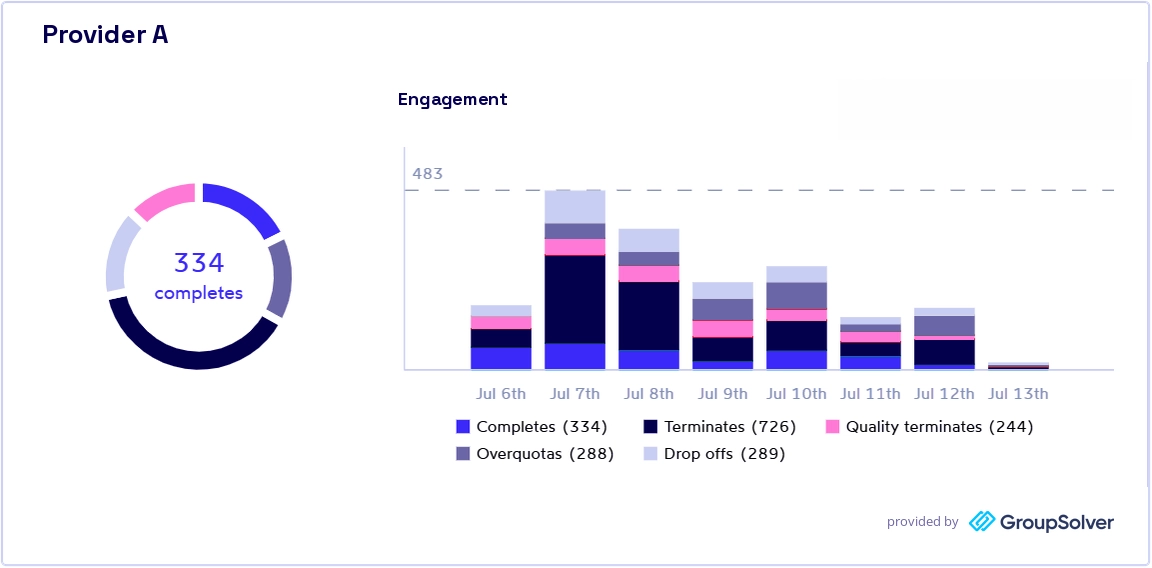
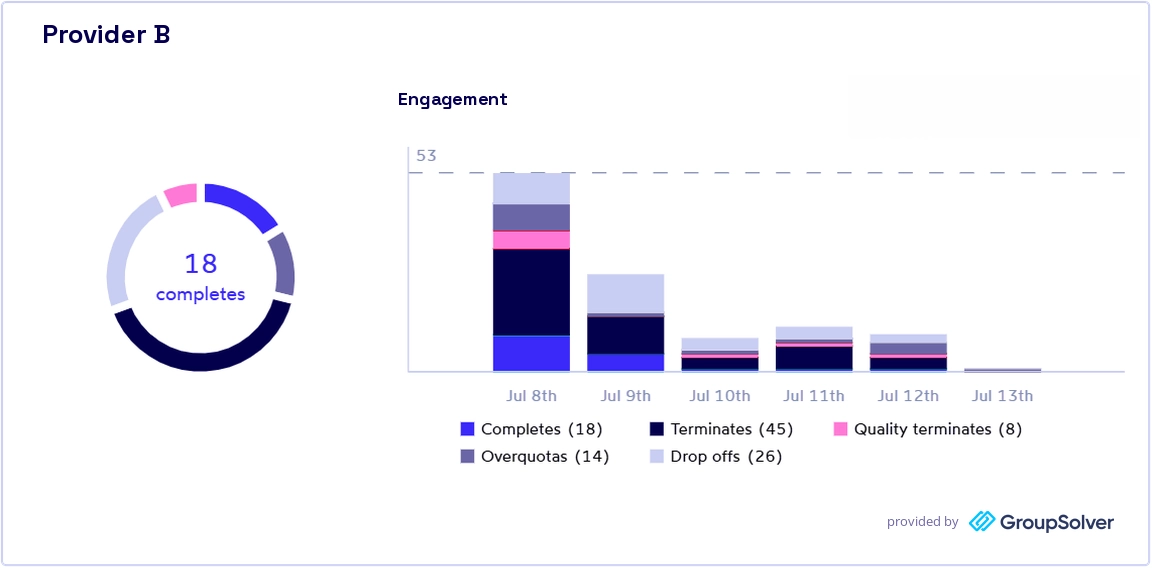
GroupSolver tracked five outcomes for every respondent. Completes qualified and finished the survey. Terminates did not meet the screening criteria. Quality terminates were ended by GroupSolver's quality and fraud checks. Overquotas qualified after their quota group had filled. Drop-offs left partway through on their own.
Each provider's quality rate is its quality terminates divided by its completes plus its quality terminates. Emporia posted the lowest rate of the three. Provider A came in at 2.4 times Emporia's rate and Provider B came in at 1.7 times. A lower rate means more of what a provider sent passed GroupSolver's quality checks. Emporia verifies professional identity before anyone joins our community, which produces higher quality respondents and a much lower quality termination rate.
Emporia delivered 97 completes with 21 respondents terminated based on GroupSolver's quality checks, the lowest rate of the three providers.
Provider A delivered 334 completes with 244 respondents terminated based on GroupSolver's quality checks, a rate 2.4 times higher than Emporia's.
Provider B delivered 18 completes with 8 respondents terminated based on GroupSolver's quality checks, a rate 1.7 times higher than Emporia's.
How does Emporia deliver high quality respondents?
Much like GroupSolver, Emporia uses multi-layer technology to assess respondent quality across three key areas: professional identity, technical and network status and respondent match quality. Because bad actors and fraudsters use AI to infiltrate studies, we employ AI to combat that activity at the same level of sophistication.
Professional identity
Emporia's B2B respondents are LinkedIn-verified and healthcare professionals are verified via their National Provider Identifier (NPI). Additionally, we confirm respondents' email domain is associated with a real, established company and match respondents against our records of past and flagged identities.
Technical and network status
We use device fingerprinting to see what devices respondents use and ensure they aren't using multiple accounts from the same device. In addition to device fingerprinting, we use VPN, proxy and Tor detection, which can catch respondents who are hiding their true location. This is a tactic click farms often use. Synthetic identity protection is also in place to catch AI-generated personas and fake profiles from becoming part of our community.
Respondent match quality
Our anti-fraud technology catches rushed answers, straight-lining and odd inconsistencies when respondents are filling out a survey. We also employ sentiment and quality analysis, which reads open answers to catch gibberish, bots and low-quality replies. Low-quality replies to questions someone with a specific profession should know are a key way to remove people who don't actually have the knowledge and experience to meaningfully answer questions in a B2B or healthcare study. And finally, we have a human-in-the-loop review process for cases that are questionable and benefit from human judgement.
Why high quality sample matters.
Fraudulent and low quality respondents render insights useless, or at worst, can lead to poor business decisions based on faulty data. If you're taking the time and resources to field a study, it's worth taking the extra steps (and the elevated cost) to ensure you're getting reliable data you can trust. It's important to remember that qualified B2B and healthcare professionals aren't likely to spend 15 minutes responding to a questionnaire for a nominal honorarium.
High quality respondents can help you:
- Avoid missed deadlines because a study had to stay in field for additional weeks in order to fill the sample size with actual clean sample
- Prevent additional hours spent manually cleaning data to ensure a quality dataset
- Spare your organization from a costly mistake resulting from using bad data to make a big business decision
- Eliminate peers questioning the validity of the data and the loss of trust that can occur if dirty data slips in
Field your next study with verified professionals.
Sample quality is what determines if your dataset is reliable enough to base major business decisions on. Don't leave your stakeholders questioning your insights. Talk to our team about sourcing 100% verified B2B or healthcare professionals for your next study.
Methodology Note: Study fielded by GroupSolver in July on behalf of a payroll and HR platform serving small businesses, across CPA and accounting advisor and small business decision maker audiences, with 449 completes in total across three sample providers. Fraud detection was performed entirely by GroupSolver's platform and applied identically to all three providers.
Flagged respondent rates are calculated on respondents who reached the end of the survey. Bases are 118 for Emporia, 578 for Provider A and 26 for Provider B. Provider B contributed 18 completes, so its rate should be read as directional given the small base.

.png)